
Improving
User Retention on
the Too Good To Go App
How we turned curious users into loyal app lovers.

Too Good To Go (TGTG) is an app that helps fight food waste by connecting users with local businesses offering discounted surprise bags of unsold food. Users can pick up these surprise bags at designated times, saving both money and reducing food waste. TGTG is a simple, effective way to promote sustainability and support local shops.
About TGTG:

The Challenge: User Retention
While TGTG attracts users initially, many stop using the app after just 2-3 times. UX mission was to uncover the reasons behind this drop in engagement and redesign the experience to
keep users coming back.

Our Initial Assumptions: What Could Be Going Wrong?
Before diving into research, we put ourselves in the users' shoes and asked, what might be causing them to leave the app?
Here’s what we thought:

Is the food too close to expiration? Maybe users are disappointed by the quality.
Are the locations inconvenient? If it’s too far, people might lose interest quickly.
Is the ‘Magic Bag’ too much of a gamble? Not knowing what’s inside might be exciting or frustrating.
Are the pickup times too rigid? Busy schedules need flexibility.
Are users struggling to contact stores for important details? Like ingredients or allergens?
Food quality
Location
Magic bag
Time
Store contact
Users Feedback:
To understand users' main issues with TGTG, we reviewed over 200 comments on Trust Pilot and Google Play.

34%

23%

19%

14%

10%
Poor Quality and
Quantity of Food
Order Cancellation
and RefundIssues
Discrepancies
Between
expectation andreality
Dietary
Restrictions
Limited
Availability


Limited Options and Inconvenient Pickup
Disappointing Orders and Misleading Reviews

Frequent Other Cancellations

The Psychology Behind the App and User Behaviors
Anticlimactic (Expectation vs. Reality)
When expectations are high and the reality falls short, it leads to a sense of letdown.
When users expect their usual groceries but get unfamiliar items, their excitement quickly turns to disappointment.


Customer Effort Score (CES)
This metric measures the effort a customer puts in to resolve an issue or complete a task.
Requiring a busy user to call the store for information increases this effort, leading to
lower satisfaction and loyalty
Loss Aversion
People feel the pain of losing something more acutely than the pleasure of gaining something of equal value.

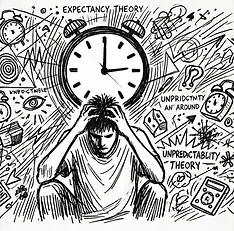
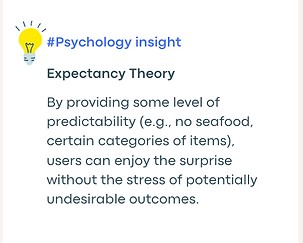
Expectancy Theory
Too much unpredictability can lead to anxiety and dissatisfaction. By providing some level of predictability, users can enjoy the surprise without the stress of potentially undesirable outcomes.
Survey:
In the survey below, I highlighted the areas with percentages almost 20% and above to emphasize the most critical issues that need attention.

-
Limited selection of food options: 50%
-
Inconvenient pickup times & locations: 50%
-
The repetitiveness of the offerings: 29%
-
Quality of the food received: 25%

-
More details of the "Magic Bag" before purchase: 52%
-
Flexible pickup time selection: 45.7%
-
Better location accuracy to find closer deals: 26.1%
-
Value for money (price-quality ratio): 26.1%
-
Filters for dietary needs (vegan, Pork-free, halal): 19.6%


-
Almost half of the users not
recommending the app is a serious
concern that requires immediate
attention!

-
Buying & picking up was inconvenient: 19.6%
-
Few nearby participating stores/restaurants:36.4%
-
Magic Bags" quality was disappointing: 22.7%
-
Pricing felt like poor value: 22.7%

User Interview:
Interviewed with +6 users, revealed the pattern of the common pain points users TGTG have.


Insights:
After collecting users’ needs and reviewing online feedback on TGTG’s shopping experience, we tried to group them, find the main themes, and synthesize our insights.
Location (Shop Shortage / Distance)
📍
The user values location-based offers, prefers nearby shops, desires more local options and restaurant choices in the app, and favors a delivery option to enhance convenience for daily needs.
Timing
⏰
The user finds the pickup timing from restaurants to be inconvenient, often too brief, requiring them to adjust their entire schedule, though they understand that it's part of the system.
Magic Bag
🎁
The user enjoys surprises but prefers the items in the magic bag to be useful in their daily life, organized into categories, and not feel like leftovers.
Quantity
🍽️
The user reported issues with quantity, including receiving too few items, getting items close to expiration, and being dissatisfied with the variety of food from restaurants.
Quality
🛍️
The user enjoys surprises but prefers the items in the magic bag to be useful, within specific categories, and not feel like leftovers.
Price
💰
The user, motivated by price, appreciates the low cost and large quantities but feels the quality doesn't match the price and would prefer lower costs and specific categories in the magic bag.
Engagement
The user wants better engagement through personalized recommendations, reviews, and community features, while also being informed about the amount of food saved per day and addressing occasional disrespectful behavior when receiving the bag.
📱
Three User Archetypes:
Combining our key insights showed us that we have three main user personas.

Persona 1:
Eco-conscious
&
Variety-seeking
Persona 2:
Budget-conscious
&
Convenience focus

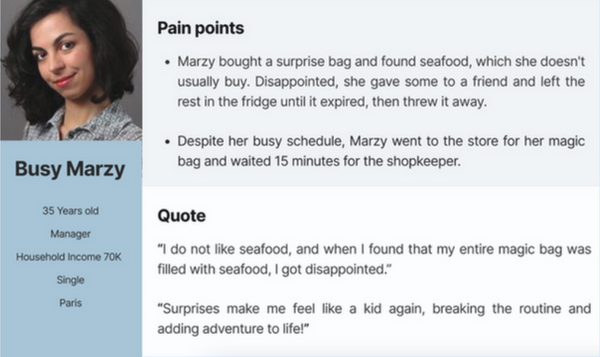
Persona 3:
Time-efficient
&
Adventurous
Learn From Our Competitors:
The insights gathered from this analysis helped us identify opportunities and best practices to enhance TGTG's user experience and retention strategies.


HMW's Statement
HMW ensures the itemsinside the bag are alignedwith the buyers needswithout showing themexactly what’s inside thebag?
HMW optimize the timing ofpickups from shops to betteralign with user expectationsand convenience?
HMW helps users to have control and awareness over the types of items when making an order.
HMW assists users in orderingfood despite inconvenientlocations?
Ideation Session:
Through brainstorming, we developed ideas aligned with business and user needs. To prioritize, we used the Impact-Effort Matrix to assess feasibility and impact.

UI Design
Now it's time to design the solutions! Let’s keep Ella, Benji, and Marzy’s pain points in mind and explore how our new design can transform their experience with TGTG.
Problem 1
HMW ensures the items inside the bag are aligned with the buyer's needs without showing them exactly what is inside the bag?


Solution 1
Categorizing the magic bag content adds a level of predictability, allowing users to purchase with greater confidence.


Problem 2
HMW help users to have control and awareness over the types of the items when making an order?


Solution 2
Offering a filter with more options, such as pork-free and halal, is essential, as a significant percentage of users follow these dietary preferences.


Problem 3
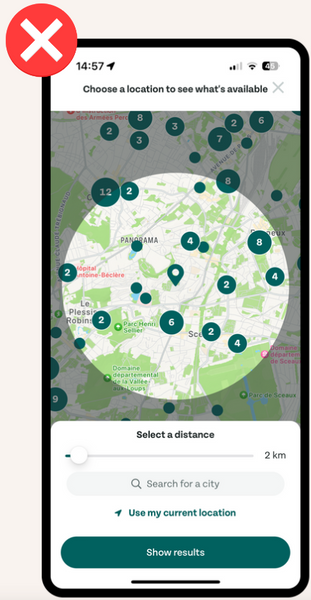
HMW assists users in ordering food despite inconvenient locations?


Solution 3
Offering a Premium feature that includes free delivery, will greatly enhance user convenience and satisfaction.


Problem 4
HMW optimize the timing of pickups from shops to better align with user expectations and convenience?


Solution 4
With the locked coolers in the store (ex: Grocery case), the users don’t need to rush to pick up their bag from the store. It’s so convenient knowing their food will be fresh and ready whenever they get there!


Take away
-
A bad first experience with an app can deter users from returning. Excessive unpredictability in the Magic Bag concept may cause anxiety and dissatisfaction, as unmet expectations lead to disappointment. When users expect familiar groceries but receive unfamiliar items, initial excitement can turn into frustration. Offering some level of predictability allows users to enjoy the surprise without the stress of unwanted outcomes.
-
People highly value convenience and are generally motivated to minimize effort. If users have to travel long distances to find deals, the effort required outweighs the benefits, leading to dissatisfaction and potential app abandonment. Premium features can address users' psychological needs to avoid losses.
-
By focusing on minimizing effort and increasing user convenience, it's important to recognize that a limited time window to collect a bag can lead to frustration, which significantly increases the likelihood of abandonment.
-
This project taught me how closely business KPIs and design concepts are intertwined and how design decisions can directly
influence these metrics, either positively or negatively.